At the beginning of my career as a web developer, I wanted to build an efficient routine that balanced practical development with learning the fundamentals of programming.
To find the best approach, I bombarded AI with questions, searched for articles and watched videos on social media, hoping each new source would help me refine my learning process.
Instead, I found myself mentally exhausted before I had put much of what I’d learned into practice.
Eventually, I understood that the real problem wasn’t a lack of motivation or discipline. It was the constant stream of information competing for my attention.
And I’m not alone.
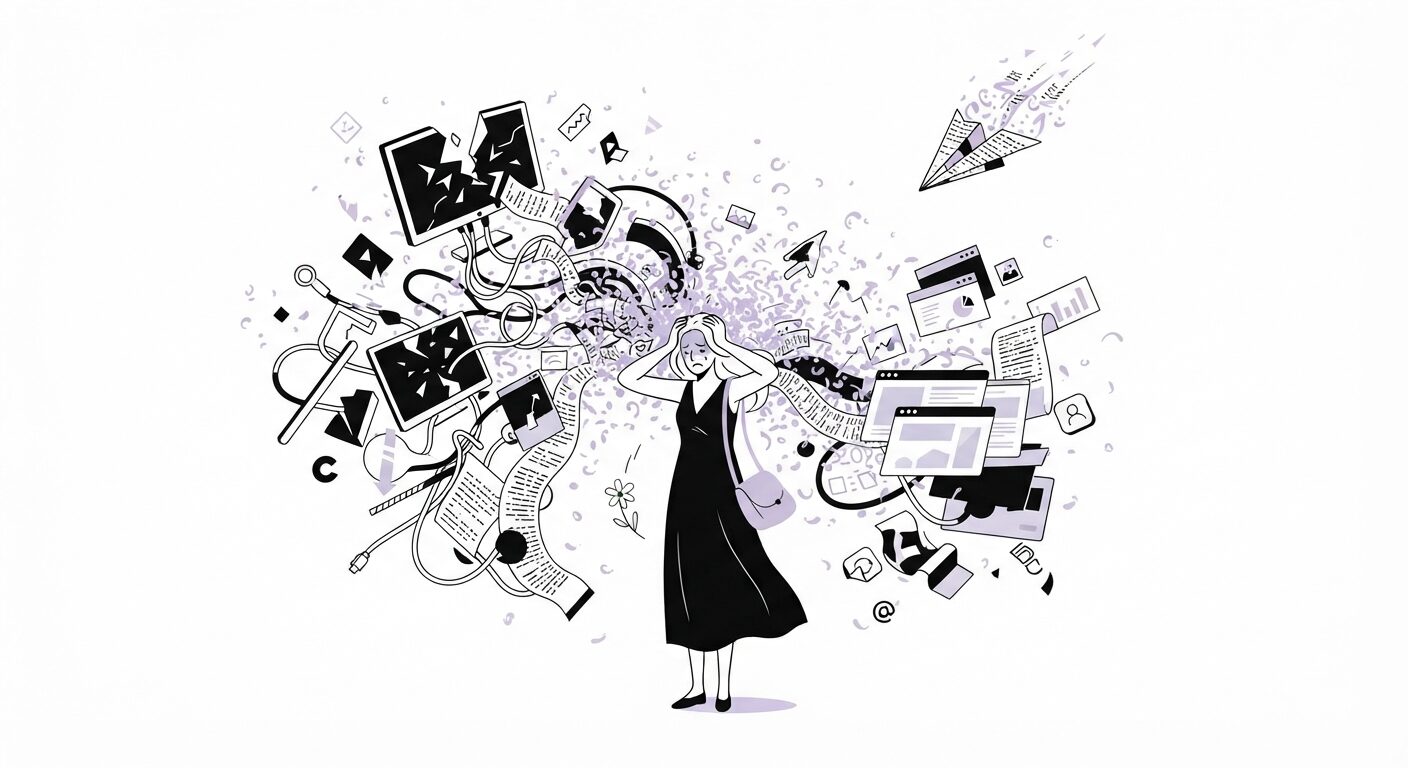
Every day, we’re surrounded by social media feeds, AI-generated answers, online articles, videos, television and advertisements—all competing for our limited attention.
Rather than helping us make better decisions, this endless flow of content often leaves us mentally exhausted before we accomplish anything meaningful.
What Is Information Overload?
Information overload occurs when we take in more information than our brains can effectively process.
Instead of improving our decisions, a constant stream of articles, videos, AI responses and advertisements makes it increasingly difficult to concentrate on what truly matters.
The challenge isn’t simply the amount of information available today. It’s that so much of it competes for our attention, regardless of whether it’s relevant to our goals.
As our focus jumps from one piece of content to another, we spend more mental energy filtering information than applying what we’ve learned.
Over time, this constant stimulation leaves us mentally drained, even after spending hours learning.
We may feel productive because we’ve consumed a great deal of information, yet we’ve made little meaningful progress.
The turning point for me was recognising that I didn’t need more information—I needed to be more intentional about what I allowed into my attention.
Here are the three changes that made the biggest difference.
1. Use AI Strategically
AI is excellent at explaining complex topics, providing a broad overview or suggesting the next step towards a goal. At the same time, it can produce far more information than we actually need.
In the beginning, I asked AI about every question that crossed my mind. One answer led to another question, then another, until I had accumulated plenty of knowledge but very little clarity.
Rather than simplifying my learning, I was making it more complicated by gathering information without first deciding what I wanted to achieve.
That experience taught me that AI isn’t inherently useful. Its value depends entirely on how deliberately we use it.
Today, I decide what I want to accomplish before opening AI. I then ask only the questions that help me move to the next step instead of collecting information for its own sake.
By changing the way I use AI, it has become a practical tool rather than an endless source of information.
This experience is closely related to how we process information in daily life.
→ Metropolitan Fatigue: what I learned from living in Tokyo
2. Reduce Unnecessary Information from Social Media
Social media platforms are designed to capture and keep our attention.
Advertisements and recommended posts constantly compete for our focus, encouraging us to continue scrolling long after our original purpose has disappeared.
I gradually realised that much of this content wasn’t helping me achieve my own goals. It was designed to support someone else’s.
To reduce unnecessary distractions, I subscribed to YouTube Premium so I could remove advertisements and watch only the videos I intentionally selected.
I also stopped browsing social media timelines without a purpose.
Now, I open social media only when I already know exactly what I want to watch or learn.
Although paying to remove advertisements isn’t the right choice for everyone, I’ve found that limiting unnecessary distractions is a worthwhile investment because it helps me protect my attention.
3. Consume TV and News Intentionally
Television and news deliver an endless stream of information.
Without a clear purpose, it’s easy to continue watching or reading simply because more content is available.
I noticed that this habit often left me mentally tired, even when I couldn’t remember much of what I’d just consumed.
So I adopted a different approach.
Rather than switching on the television to see what happened to be on, I decided in advance which programmes I genuinely wanted to watch.
I applied the same principle to online news by choosing a specific topic before opening a news website.
I also began recording television programmes so I could watch them when it suited me instead of following a broadcast schedule.
These small changes reduced unnecessary sensory stimulation and allowed me to spend more of my time and energy on information that genuinely mattered.
Conclusion

Looking back, I believed that becoming a better web developer meant keeping up with the latest information as quickly as possible.
What I eventually discovered was that constantly chasing new information was slowing my progress instead of accelerating it.
The answer wasn’t to learn more. It was to become more selective about what deserved my attention.
Using AI with a clear purpose, reducing unnecessary distractions on social media and consuming television and news intentionally have all helped me reduce sensory fatigue and focus on what truly matters.
Information itself isn’t the problem.
The real challenge is deciding what deserves our attention.
In a world where information is unlimited but our time and energy are not, learning what to ignore can be just as valuable as learning what to consume.
This connects closely with how our environment affects us physically and mentally.